Inner development explained
Inner development is the strategic capability behind execution. It’s what turns strategies into behaviour, teams into aligned collectives, and leaders into people others follow.
What is inner development?
Inner development is the growth of the human capacities we need to navigate complexity, collaborate honestly, and create change that lasts.
The 25 inner skills – from inner compass and complexity awareness to communication, courage, and creativity — are the concrete capabilities behind leadership, teamwork, and change.
Research shows they matter more for leading through complexity than technical expertise. Yet they remain the most underdeveloped area in most organisations.
That gap is what inner development addresses.
The word “inner” often makes people think of personal growth or soft skills. In fact, inner development is one of the most concrete, trainable, and measurable capabilities in any organisation — because it’s what strategy execution actually depends on.
Outer change starts within
Every major change theory, from Kurt Lewin to Otto Scharmer, converges on the same insight: outer change is powered by inner change. You cannot transform an organisation without transforming the people inside it.
- A leader who develops self-awareness makes decisions people actually follow.
- A team that builds psychological safety produces innovation that would otherwise stay silent.
- An organisation that develops complexity awareness delivers on strategy that would otherwise stall.
Strategies fail on people, not paper. Inner development is what fixes that.
That’s why we built the Inner Development Kit – to make this insight practical.
From academic framework to tangible tools
The Inner Development Goals (IDG) framework is a rigorous, research-based model. It identifies 25 inner skills across 5 dimensions, co-created by more than 30 researchers, coaches, and practitioners across psychology, systems science, leadership, and sustainability.
But like most academic frameworks, it doesn’t come with a way to actually use it.
That’s where the Inner Development Kit comes in.
We took the framework and translated it into three things you can put in your hands:
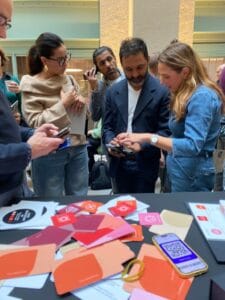
- A physical toolkit with dialogue cards, skill cards, and an assessment card — so any team, coach, or leader can start a conversation about inner development without training.
- An online assessment tool for individuals, teams, and 360 — so you can measure and reflect on where you stand, tied to a specific goal.
- A facilitation approach you can learn — through workshops, an online course, and consulting.
You don’t need to know the IDG organisation to use the Kit. You don’t need to be a change consultant or a psychologist. The tools are built for anyone who wants to make the inner side of change practical.
That’s what we mean when we say Inner Development Kit builds the human capability that makes strategy executable.
Explore the Kit · Try the free online assessment · Book a workshop or course
The academic backbone
Inner development is not a new-age idea. It’s a research-based framework being applied and studied in academic institutions worldwide.
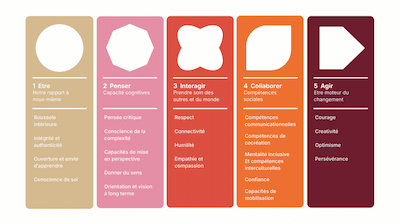
The 5 dimensions and 25 inner skills
The IDG framework identifies 25 skills across 5 dimensions:
- Being — Relationship to self. Inner compass, integrity, presence, awareness.
- Thinking — Cognitive skills. Critical thinking, complexity awareness, perspective-taking.
- Relating — Caring for self, others, and the world. Empathy, compassion, trust.
- Collaborating — Social skills. Communication, co-creation, inclusive mindset.
- Acting — Enabling change. Courage, creativity, optimism, perseverance.
The full list of 25 skills is built into every part of the Inner Development Kit — from the dialogue cards to the online assessment. When you rate yourself on the 25 skills, you’re mapping your inner infrastructure. When you reflect on which ones your goal depends on, you’re building a growth path.
See the 25 skills in the online assessment
Used at universities across Europe
Universities integrate the Inner Development Kit into leadership development, teacher education, and student wellbeing programmes, eg. through the Erasmus SEA-EU programme. At Artevelde University of Applied Sciences (Belgium) more than 200 students used the assessment, and at Rotterdam University of Applied Sciences (Netherlands) they implement the inner development perspective as part of their curriculum.
Officially aligned with the IDG initiative
Sara Øllgaard, the Kit’s creator, is an official IDG Ambassador – meaning the Kit is recognised as a practical tool for facilitating the framework. Sara is also a Certified Co-Active Coach and Team Coach, holds a Master in Leadership and Innovation, and is a graduate of KaosPilot.
Grounded in research from leading thinkers
The framework itself draws on decades of research from thinkers like Amy Edmondson (psychological safety), Otto Scharmer (Theory U), Peter Senge (systems thinking), Robert Kegan (adult development), and others – together covering all five IDG dimensions.
Read more about the researchers in the FAQ below.
FAQ
Ready to bring inner development into your work?
Whether you’re leading a team, running a workshop, coaching individuals, or teaching students – inner development offers a structured, practical path. We’ve built the tools to help you facilitate it.
Reach out – if you are not sure where to start.